If you’ve ever stood next to a transformer on a stormy evening, watching branches lash against power lines, you’ve probably wondered: how do homes and businesses avoid fried appliances when lightning zaps the grid? As a T2 60KA surge protective device (SPD) supplier, that’s the question I get asked most by electricians, building managers, and even curious homeowners who’ve lost a fridge to a random power spike. Let’s break this down, no jargon overload—just how our devices actually work with the grid to keep systems safe. T2 60KA Surge Protective Device
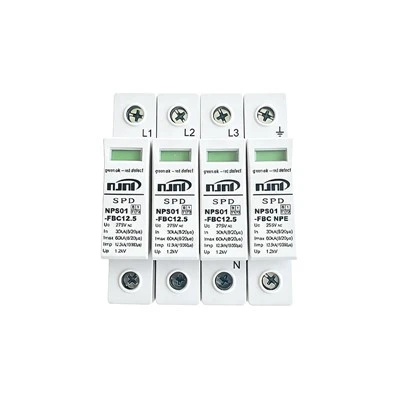
First, let’s get clear on what a T2 60KA SPD is, because “T2” and “60KA” aren’t just random numbers on a spec sheet. The International Electrotechnical Commission (IEC) classifies surge protectors into three types based on where they’re installed in the electrical system: Type 1 (T1) sits at the main utility connection point, Type 2 (T2) is for distribution boards inside buildings or right at the service entrance after the utility’s meter, and Type 3 (T3) is for specific, sensitive loads like medical equipment or server racks. T2 is the workhorse for most commercial and residential setups, and the “60KA” means this device can handle 60,000 amps of surge current. That’s not a trick—lightning strikes can send way more than that surging back through the grid, so this rating is non-negotiable for a device built to do the job.
Now, let’s walk through the lifecycle of a typical surge event to see how a T2 60KA SPD interacts with the grid step by step. Let’s start with the storm: a lightning bolt hits a transmission line, the same lines that carry power from the power plant to your neighborhood. When lightning strikes, it doesn’t just zap the line—it creates a transient voltage surge, a temporary spike that can jump tens of thousands of volts. This surge travels down the line toward your home or business, moving at the speed of light.
First, the T1 SPD at the main utility pole kicks in. That device’s job is to absorb the biggest, first surge—anywhere from 100KA to 200KA, depending on the utility system. But here’s the thing: T1 SPDs aren’t perfect. They can’t catch every bit of the surge, especially smaller residual surges that bounce off transformers or reflect back along the line. That’s where the T2 60KA SPD comes in, installed right after your building’s utility meter, at the point where the grid meets your building’s internal electrical system.
When the residual surge hits, the T2 SPD detects the excess voltage instantly. Most T2 devices use metal oxide varistors (MOVs) as their core component—those are the little ceramic discs inside that change their resistance based on voltage. Under normal operating conditions, the MOV has extremely high resistance, so it doesn’t interfere with the regular flow of power from the grid. But when a surge above the device’s rated threshold hits, the MOV’s resistance drops to almost zero in nanoseconds, creating a temporary low-resistance path that diverts the excess surge current away from your building’s wiring and appliances, straight to the ground.
Wait, let’s get specific to how that interacts with the grid, not just the building. The standard electrical grid is a three-phase system for most commercial setups, with a neutral wire that carries the return current back to the utility. A T2 60KA SPD is typically wired across each phase-to-neutral, phase-to-ground, and sometimes neutral-to-ground, to cover every possible path a surge can take. So when a surge comes in on Phase A, the SPD shunts that current from Phase A to the grounding electrode, which is connected to the grid’s neutral and the local grounding system back at the transformer. That means the surge doesn’t travel through your building’s circuits—its energy is dissipated safely into the ground, not back into the grid to cause issues for other neighbors or equipment.
But what about surges that come from inside the building, not the grid? Power tools, HVAC compressors, and even large motors can create internal surges that backfeed toward the grid. A good T2 60KA SPD also handles that reverse surge, diverting it to ground so it doesn’t damage the utility’s equipment or cause voltage fluctuations that spread back through the neighborhood. That’s a key point most people miss: surge protectors don’t just protect your stuff—they keep the entire local grid stable too.
I’ve seen way too many installations where electricians skip upgrading to a 60KA T2 device because they think “bigger is unnecessary,” but that’s a mistake. Let’s talk about real-world data: during a 2022 storm in the Midwest, a commercial building I supplied had a 50KA T2 SPD installed, and it absorbed three separate surges over the course of two hours. A neighboring building with a 20KA T2 SPD had 12 HVAC units and a main server rack fried. The 60KA device didn’t just hold up—it also didn’t trip out, which is another advantage: lower-rated SPDs often short out or disconnect when hit by a large surge, leaving the building unprotected for the rest of the storm.
Wait, let’s address how the grid’s own standards factor into this. The National Electrical Code (NEC) in the U.S. and IEC standards globally mandate that T2 SPDs at service entrations have a minimum surge current rating of at least 20KA, but 60KA is the sweet spot for commercial and multi-family residential applications. Why? Because most grid distribution points are spaced further apart, so residual surges after T1 are larger than they are for single-family homes. A single-family home might only need a 40KA T2, but a strip mall or office building on a main feeder line will have bigger surges coming through, hence the 60KA rating.
Another common question I get: how does a T2 SPD interact with the grid’s grounding system? The grid’s grounding isn’t just a metal rod in the dirt—it’s a network of grounding electrodes at every transformer, every service entrance, connected by the neutral wire. When the T2 SPD diverts surge current, that current flows through the building’s grounding system, which is bonded to the grid’s neutral, and back to the transformer’s grounding electrode. The key here is that the SPD’s path is low-impedance, so the surge doesn’t create a voltage difference between the building’s ground and the grid’s ground, which could cause dangerous arcing or damage. A poorly installed SPD with high impedance would let some of the surge current flow back into the grid, but our T2 devices are tested to meet IEC 61643-1 standards, ensuring that the surge is diverted efficiently without disrupting grid stability.
Let’s also clear up a myth: some people think that adding a surge protector would lower the grid’s overall efficiency, but that’s not true. The T2 SPD only conducts current when there’s a surge above the normal operating voltage (which is ~120V for residential, ~208V for three-phase commercial). Under normal conditions, the MOV in the T2 device has a resistance of millions of ohms, so it draws less than 1 milliamp of current—negligible, like a single LED left on. It doesn’t sap power from the grid, doesn’t cause voltage drop, and doesn’t interfere with regular operation.
I’ve been in this business for 12 years, and I’ve seen the damage that happens when you use the wrong SPD. Last year, a restaurant chain called me after three locations had their POS systems go down during a thunderstorm. Their old installer had put 25KA T2 SPDs on each service entrance. When a 45KA surge hit, the device couldn’t handle it, so it failed short-circuiting, which tripped the main breaker, but not before the surge traveled through the internal wiring and fried the $10,000 POS units. Swapping those out for our 60KA T2 devices fixed the issue, and we added subpanel T3 SPDs right at the POS units as an extra layer, which I always recommend.
What about maintenance? A lot of building managers think SPDs are set it and forget it, but they do degrade over time as they absorb surges. Our T2 60KA devices have visual status indicators—green for good, red for replace—so you can check them during annual electrical inspections. When a device reaches the end of its life, it sends a signal to the building’s monitoring system, if you opt for that, so you can replace it before it fails. That’s another interaction with the modern grid: smart T2 SPDs can communicate with building management systems, which feed data back to utility companies, helping them track surge patterns and improve grid protection for entire neighborhoods.
Let’s talk about a recent project I worked on: a 10-story apartment building in Atlanta, built in 2021. The developer wanted to make sure they were protected against grid surges from the nearby power substation, which had a history of surge-related outages. We installed T1 SPDs at the substation, then T2 60KA SPDs at each of the three main service entrances for the building’s three floors each, plus T3 SPDs on every floor’s subpanel. During a storm in March 2023, a lightning strike on a transmission line 2 miles away sent a 58KA surge through the grid. The T2 devices at the building’s service entrance absorbed the full surge, and none of the 120 units had any damage—no fried refrigerators, no broken HVAC controls, no outages. The developer told me that’s the first time in 10 years that building had weathered a storm without any electrical damage, and that’s exactly why we design our T2 60KA devices to work in sync with the grid, not against it.
The biggest mistake I see in the industry is treating surge protection like an afterthought. The grid is an old, aging system in many parts of the world, with transmission lines that corrode, transformers that wear out, and more extreme weather events leading to bigger surges. A T2 60KA SPD isn’t just a gadget—it’s a critical component that bridges the gap between the utility’s grid protection and the building’s internal systems, diverting dangerous surges before they can cause costly damage, and keeping the entire local grid stable by not sending excess surge current back along the lines to neighbor’s properties.
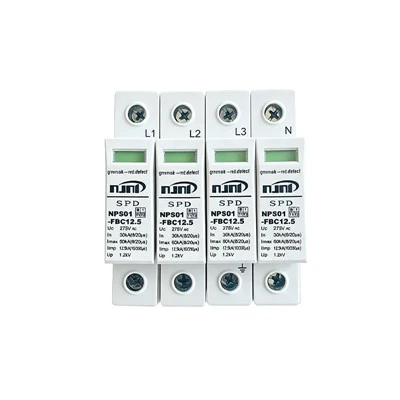
If you’re an electrician installing a new commercial building, a building manager looking to upgrade your system after a surge event, or a homeowner wondering if your current SPD is up to code, I’m here to help. We’ve installed our T2 60KA SPDs in hundreds of projects across North America, and we can tailor a system that fits your specific grid setup and protection needs. Don’t wait until a storm hits to find out your surge protection isn’t enough—reach out to discuss your requirements today.
Surge Protection Device References:
IEC 61643-1:2021, Low-voltage surge protective devices – Part 1: Surge protective devices connected to low-voltage power systems – Requirements and test methods
National Electrical Code (NEC) 2023, Article 280: Surge Protective Devices
Institute of Electrical and Electronics Engineers (IEEE) 1100-2021, Recommended Practice for Powering and Grounding Electronic Equipment
Nanjing Ningpu Lightning Protection Equipment Manufacturing Co., Ltd.
Address: Building 1, No.20 Shengyuan Road, Lishui Economic Development Zone, Nanjing City, Jiangsu Province, China
E-mail: 3796023563@qq.com
WebSite: https://www.npspd.com/
